
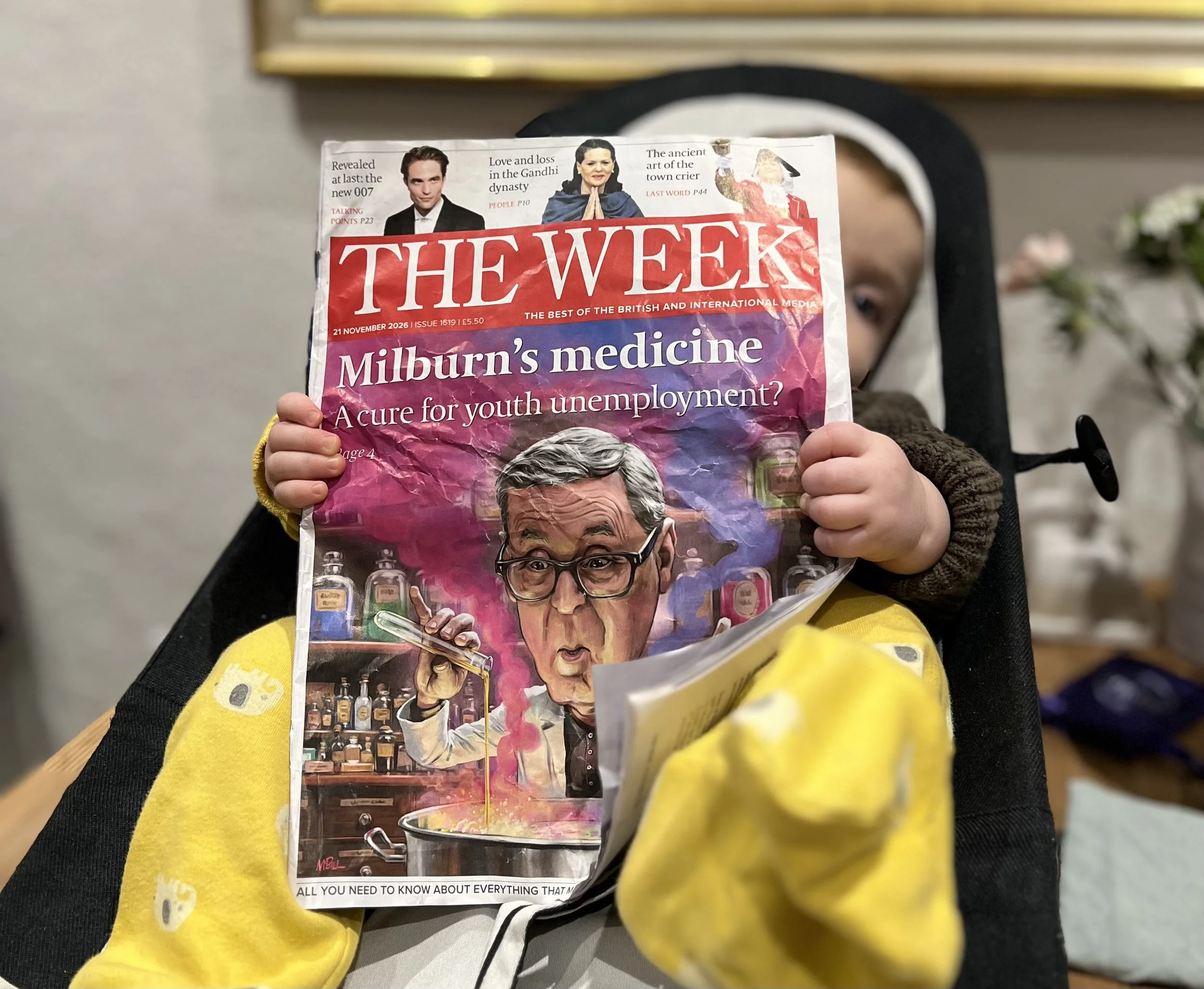
My son is looking at me and smiling. He makes a noise to get my attention, and my eyes lift from the pages of The Week, a magazine I have a near addictive relationship with.
I smile back. Then I go back to reading.
I’m trying to do two things at once, and doing both badly. If they were competing for my attention, one of them is winning, and it isn’t my son. Not in that moment, anyway.
David Foster Wallace once said: “In the day-to-day trenches of adult life, there is actually no such thing as atheism. There is no such thing as not worshipping. Everybody worships. The only choice we get is what to worship.”
So who, or what, do you worship?
Here’s another way to ask it. Who or what has your attention, most of the time?
That’s a different question from where you are or who you’re with most of the time. In a distracted world, for many of us, the answers are quite different.
Where our time, our attention and our presence actually go is what we worship, whatever we say.
I say I’m devoted to my son. I am. And I don’t always show it, and I know that too. Living with those two truths side by side is painful, and deeply human.
A friend recently told me the Arabic word for human, insān, has two possible roots: one means to forget, the other means intimacy. Perhaps we are both. Made for closeness, and forever forgetting it.
The other morning I was walking with him in the carrier on my chest, lost in a conversation from the day before, replaying what I wish I’d said. Then I looked up and saw a rainbow, and wondered how long it had been there. I looked down and saw my son looking up at me, and wondered how long he’d been doing that.
Two beautiful things, and I’d missed them both.
It’s easy to think the false gods are out there. Like the phone, the news, the inbox. And they are, but often the most demanding one is inside our own heads, pulling up the past we can’t change and the future we are already trying to control.
And all false gods have one thing in common: they don’t love us back. The news doesn’t know I exist. Nor does the beer, or the brands I like to wear, or the LinkedIn algorithm. And the voice that tells me I’m a terrible father, though I give it plenty of airtime, cannot see the full picture.
People once worshipped the sun, the rain, the rivers and the trees, because they give life. The things worth our attention are the ones that give something back. There are people wanting to love us. Flowers wanting us to receive their beauty. And work that cares about us because we care about it.
“Attention is the beginning of devotion”, Mary Oliver once said. But it’s only the beginning.
Appreciation is a step up. It has imagination, gratitude and empathy in it. It also has power, because it's creative. A stranger’s face lights up when we smile at them. Appreciation is contagious. Withheld, it can destroy. The people around us get an unspoken and very convincing message that something else matters more than them.
So appreciation may be the most fundamental form of security we can give those we love.
And yet, in the name of material security and achievement, it’s so often the very thing we men hold back.
What we give our attention and appreciation to fills our days. In time, it fills us; it’s who we become.
Purpose, as I see it, lives in the unique quality of attention and appreciation we bring to our participation with life. Without it, there’s no purposeful life, only a busy one, and often a lonely one too.
I want to give my power to the things I love and to things and people that give back. It’s so simple, and yet I keep failing.
It may be the most important decision I make, over and over, every day. My habit of forgetfulness is at the helm most of the time.
I think this is the human work of a lifetime, practised in the day to day trenches.
So, who will you give your attention to today and will they know it?
The Journey
The Journey is, in many ways, a six-month practice in this: choosing what we give our attention to, and so what we give our lives to. I won’t tell you what or who to worship, of course. But together we create the conditions for you to choose, over and over again, until it becomes habit.
Six men. Twelve modules. Time alone on the land. It begins on Wednesday 13 January.
Registration closes when Module 1 goes out on 4 January, or sooner if the six places fill. With the holidays in between, I’d suggest getting in touch by mid-December so we have time to talk.
P.S. My last free workshop of the year is on Wednesday 2 December, 7.30pm UK, if you’d like to experience the work first.